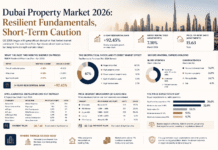

















Dubai ranks third in the world for prime price growth, fourth for bubble risk and among the cheapest major cities to buy relative to income. Citywide values sit 10.2% below their February level. This assessment places Dubai among the world’s leading housing markets, drawing on data published in September 2026.
The global backdrop: a split market
The world housing market doesn’t moves as one. Global Property Guide data shows several European markets up more than 40% in three years. Montenegro leads at 70.5%, Bulgaria follows at 53.3% and Portugal at 46.6%. France, Finland and Luxembourg still trade below their levels of three years ago. In Asia, Vietnam gained 61% while Macau lost 23.6%.
Headline growth also hides inflation. The UBS Global Real Estate Bubble Index 2026, released this month, tracks inflation adjusted prices across 23 cities. Average real growth slowed to 0.5% in the year to mid 2026, down from 1.4% a year earlier. Seoul led at 11.0%. Toronto trailed with a 10.7% fall.
Strength concentrates at the top of the market. Knight Frank’s Prime Global Cities Index, also published this month, shows luxury prices up 2.6% in the year to June 2026, with 32 cities rising and 15 falling. The bubble report links prime outperformance to equity market gains, concentrated AI wealth and cash purchases. Any fair comparison between markets separates prime from mainstream and nominal from real.
Dubai against the world’s prime markets
Dubai ranks third in the prime index, with luxury prices up 10.9% in the year to June. Tokyo leads at 50.7% and Manila follows at 14.6%. Over five years, Dubai prime prices rose 155.3%, the strongest result of any city in the index.
The citywide picture differs. ValuStrat’s August index, released in September, stood at 218.8 points, down 0.2% on the month and 3.1% on the year. Values now sit 10.2% below February. Apartments fell 5.3% year on year. Villas fell 1.7%, their first annual decline since 2021.
The bubble index measures the same shift in real terms. Real prices rose 0.4% over the year to the second quarter and real rents fell 4.0%. After real growth above 10% in 2025, the market paused at the onset of the conflict involving Iran in late February. The index draws its Dubai price and rent series from REIDIN.
The pace of decline has slowed. In August, 61% of freehold apartment communities and 73% of villa communities held their values. The prime index tracks the luxury segment in nominal terms. The two broad market series track the city as a whole. Read together, they describe two markets moving at different speeds.
How Dubai’s correction compares
Dubai’s adjustment runs shallower than the corrections other global cities absorbed after 2021. Dubai values stand 10.2% below February. Toronto prices sit nearly 30% below their peak and Frankfurt nearly 25% below its 2021 peak in real terms. Paris has fallen 25% in real terms since 2021, and London sits more than 15% below its 2021 level.
The Dubai figure is nominal and covers the months since February. The others mostly run in real terms over up to five years. Even allowing for the difference, Dubai’s decline stays modest by global standards.
The bubble study finds the cities rated high risk in 2021 later recorded the sharpest declines, averaging about 3% a year in real terms. Dubai entered 2026 at elevated risk after real growth above 10% in 2025. Its mortgage lending score stays low, which points to continued softening in weaker segments rather than a credit driven break.
- Read more: Dubai Real Estate Soft Landing
Affordability and risk
By global standards, Dubai remains inexpensive to enter. A skilled service worker needs about five years of income to buy a 60 sqm apartment near the centre. Hong Kong requires 15 years and London 11. Dubai also belongs to a small group of cities where the full economic cost of owning falls below the cost of renting, alongside Madrid, Lisbon, Seoul and Zurich.
The bubble index still places Dubai fourth of 23 cities for risk. Its score of 1.16 sits in the elevated band and rose from 2025. The subindex detail explains the gap. Mortgage lending scores low. Construction scores moderate. The only high band reading comes from Dubai’s inflation adjusted price index.
Price momentum drives the Dubai score, not credit or stretched valuations. Momentum can reverse without a debt problem attached. The flag reads as a warning about pace, not leverage.
Financing costs rose this month. The Central Bank of the UAE lifted its base rate by 25 basis points to 3.9%, effective 17 September, after a matching move by the US Federal Reserve. Variable rate borrowers and owners whose fixed periods end soon face higher repayments. The increase weighs on mortgage buyers far more than on cash buyers.
Dubai yields against global cities
A price to rent ratio converts into gross yield. Dubai requires 16 years of rent to buy an apartment, among the lowest multiples in the bubble study. A ratio of 16 implies a gross yield of about 6.3%. Seoul at 25 years translates to about 4.0%. Geneva at 40 gives 2.5%, and Zurich at 46 gives about 2.2%. Munich, Frankfurt and Hong Kong all sit above 30, below 3.3% gross. These figures exclude service charges, vacancy and fees.
The study attributes Dubai’s low multiple to a less regulated rental market, higher interest rates and an elevated risk premium. For income investors, the premium forms the return. A higher cash yield comes with more volatility. Sterling Capital Real Estate puts the average rental return in Dubai at around 6%, in line with the conversion.
The income side has shifted toward tenants. An analysis of Dubai Land Department tenancy registrations by fam Properties found new leases outnumbered renewals by 2,139 contracts in August, the first such reversal since the dataset began in January 2023. New lease rents for the same building and unit type sat 15.3% below January levels, while renewal rents fell about 1%. The median rent on new apartment leases reached AED 94.6 per sq ft in August, 8.3% below its October 2025 peak.
Tenants now move to capture lower rents. Yields calculated on renewal figures or last year’s rents overstate current income. New lease rents give the more accurate reading.
Resale: ready volumes slip, value holds
Ready home sales fell back in August after two months of gains. The month recorded 3,038 ready transactions, down 14.3% on July and 20.6% on a year earlier.
July had risen 11.4% to 3,546 deals.
The ready market still carries the larger share of value. Projectory Research counted AED 180.05 billion in ready sales from 35,370 transactions between January and August, based on land registry records. Off-plan produced AED 169.77 billion from 76,650 transactions over the same period. Ready buyers pay higher tickets for completed stock.
Resale pricing splits by location. Among apartment locations, Jumeirah Beach Residence fell 16.9% year on year, Town Square 9.7% and Palm Jumeirah 8.6%. Dubai Silicon Oasis led annual gains at 4.3%, followed by Dubai Sports City at 4.2% and Al Quoz Fourth at 3.9%. Ready sales concentrated in Jumeirah Village Circle at 12.1% of deals, Business Bay at 6.1% and Dubai Marina at 5.9%.
The gap between January peak prices and August values now shapes resale negotiations, with apartments in the weakest locations showing the widest spread.
Off-plan versus ready
Off-plan still dominates by count, and it is cooling faster. August brought 8,016 off-plan registrations, 72.5% of residential sales. Registrations fell 15.4% on the month and 40.4% on the year. Ready sales fell 20.6% over the same twelve months. Azizi Venice alone took 19.8% of August off-plan deals.
New supply is slowing at the source. AGBI reported this month, citing Savills, a fall of almost 90% in off-plan launches between the first and second quarters, while completions reached their highest level in five years.
The two segments carry different profiles. A ready unit produces income from the day of transfer and a price buyers can check against recent resale transactions. It also ties income to new lease rents, which now run well below January.
An off-plan unit spreads payments over stages at developer pricing. Its exit price and first tenancy depend on the supply landing alongside handover. The cut in launches thins the pipeline for later years, while units already sold continue to deliver. Developer delivery records carry more weight in this phase. Villas and supply constrained communities face less of this risk than apartments in high delivery corridors.
Who is still buying
The top end continues to trade. August recorded 14 ready transactions above AED 30 million, 12 of them above AED 50 million. In the first week of September, a six bedroom villa on Palm Jumeirah sold for AED 260 million.
The bubble report names uncertainty over the return of high income arrivals as the main weight on Dubai’s premium segment. The transaction data shows this uncertainty has not stopped the largest deals.
Activity picked up after the summer. Official figures for 7 to 11 September showed AED 10.67 billion in total real estate transactions, above the AED 7 billion to AED 9 billion weekly range of July and August.
Dubai’s global position now
Measured against the world, Dubai combines top tier prime growth, some of the lowest entry costs among major cities and a correction milder than most. Its prime and citywide segments now behave as separate asset classes. Prime prices keep compounding on global wealth. The broader city carries a 10.2% correction from February, falling new lease rents and higher borrowing costs. Gross yields run two to three times those of Zurich or Geneva.
The data points in clear directions. Ready units in communities with limited new supply hold the strongest income case, measured on new lease rents. Prime property and villas show more resilience than apartments in weaker locations. Off-plan outcomes hinge on developer delivery records and the supply scheduled around each handover. Financed purchases now carry higher repayments at the new base rate.
The bubble report expects an improved geopolitical backdrop to bring a fast recovery in sentiment and price expectations. Assets the coming supply cannot replicate stand to gain most from it.